Roots on Russell
By Cris Cadiz
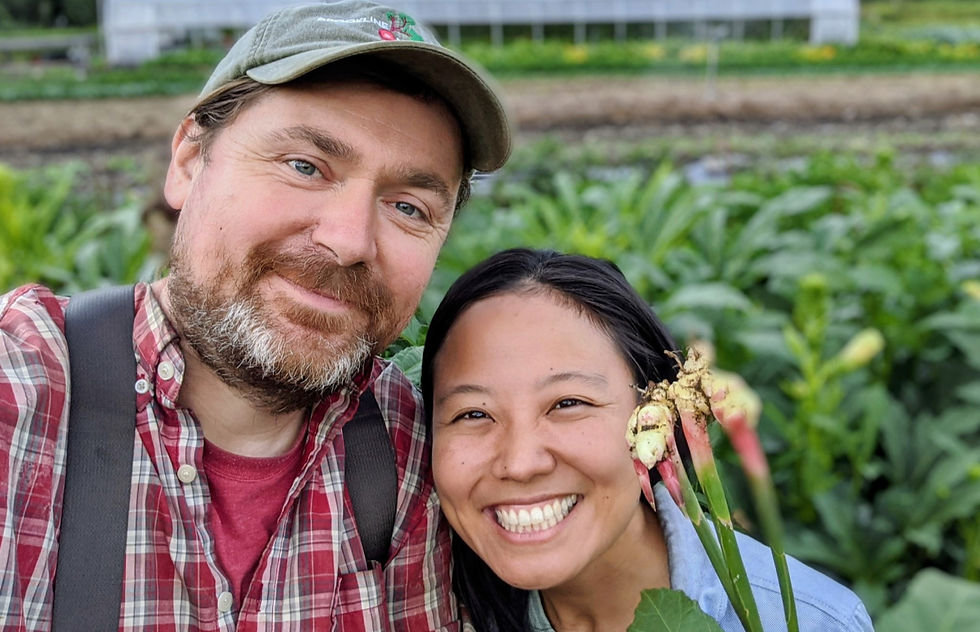
Roots on Russell is a small property anchored by a modest white Cape in a residential area of Tolland. Kathryn Bombard and Tim Schoenborn moved there in 2019 and started growing for themselves during Covid. “We were big pasta fans, so we thought why don’t we start growing stuff to make our own sauce?” Tim recalls. They started with ten tomato plants, realized they needed garlic and onions “…and it just kind of snowballed from there,” he says. They started selling to the public at the Tolland Green Market three years ago. In a few short years, they have built a tiny but productive farm on ¾ of an acre within earshot of traffic buzzing along I-84, proving you can successfully grow food for the community in small spaces.
Their neighbors’ yards are typical suburban green lawn and perennial beds. Kathryn and Tim’s yard is completely fenced in (to keep out critters) and planted with kale, potatoes, garlic, asparagus, raspberries, tomatoes and more. Thirty steel “Birdie” raised beds imported from Australia contain more veggies in tidy, metal containers. A petite front yard is lush with apple trees, cutting flower beds and an asparagus bed, lacy foliage waving in the breeze among snapdragons and rudbeckia. “That’s where we started,” Tim says pointing to the front yard. “We're farmers in the loosest of terms. We are more like extreme gardeners,” he jokes.
Despite its diminutive size and multi-tasking as home/yard/garden, this property is a full-on farm. The back yard morphs quickly from living space to growing space. A small wooden deck off the house steps down to stone patio, fire pit, Adirondack chairs next to raised beds of frilly kale, rainbow Swiss chard, lettuce and cucumbers, their curly vines suspended from a clever trellis repurposed from old chain link fence (great for air flow and easy harvesting). Last year, they cleared fifteen trees from the side yard for more growing space and sunlight. Chopped wood is piled up waiting on winter to feed their wood stove. Pale chips from ground stumps mulch paths among newly planted rows.
Roots on Russell seems the perfect size for two people. “I think our ambition here was to show what you can do without a lot of space,” says Tim. That said, they have just purchased a 17-acre lot a few minutes up the road from their house in Tolland. They are not rushing to expand, however, taking time to plan how best to use the land.
In addition to growing enough food for the weekly Tolland Green Market, they are Market Managers for the Stafford Farmers Market AND work other jobs. Tim is a full-time senior custodian at Simsbury Middle School. His weekday 7am to 3pm position offers benefits and allows him to get home before the sun sets to farm. He attributes his strong work ethic partly to working on a family dairy farm in New Hampshire every summer for four years as a teenager. “You wake up at three in the morning; you milk the cows twice a day. You have to do this… We were growing corn and hay for the cows, not vegetables, but I think that’s why we ended up here. I kind of missed it.”
Up until this July, Kathryn worked at a restaurant full-time as a bartender and server. Before that, she worked full-time at Travelers plus bartending part-time. Since Covid, she also farmed. “I realized there are not enough hours in the day,” she says. Now she farms full time, manages the Stafford Farmers Market (a full-time job in itself!) and travels throughout the state offering pop-up farmer’s markets at senior centers or senior housing.
Kathryn enjoys providing seniors with fresh food through the FMNP (Farmers Market Nutrition Program). This state-funded benefit allows eligible low-income individuals, including seniors and families, to purchase food at farms or farmers markets. Many farmers markets will double these benefits, so it’s a valuable means to purchase healthy, local food. Unfortunately, many seniors either don’t have transportation, or their towns don’t have a market that accepts FMNP. Bringing the market to them allows seniors access plus avoids wasting the benefits. “I just load up my car with some produce and bring it to them,” Kathryn says. “It’s adorable. They get so excited.”
The organizers of the FMNP program, the CT Department of Agriculture, asked for farms interested in doing pop-ups. “I said yes,” says Kathryn. “They say it’s very hard to get people willing to travel for this, so I’m happy to do it.” She currently attends two senior centers in Manchester and two in Tolland. She has traveled to Branford, Marlborough and is headed to Bristol this year for the first time.
Roots on Russell is also SNAP certified, thanks to help from Grown Connected. “Petros [of Grown Connected] walked me through the application process,” says Kathryn who was surprised at the challenge for farmers to support this federal program. Although SNAP allows low-income people to buy fresh, healthy food, Kathryn and Tim know transportation to farms or markets can be an issue. Education is also helpful. “Sometimes people don’t know what kale or Swiss chard is or how to prepare it,” says Tim. He recalls when he was a kid thinking green beans came in a can from Del Monte. “We have to change the dynamic that fresh food is actually attainable, accessible and it doesn’t have to be expensive,” he adds. At markets, Roots on Russell sometimes offers print recipes or Grown Connected’s recipe cards that link to a recipe library or provide additional information on produce.
“We're not certified organic, but we grow organically,” says Tim of their practices. They do everything by hand. They don’t own a tractor; they don't use any synthetic fertilizers, herbicides or chemical pesticides. Tim feels they have learned a lot in a few short years and appreciates the farming community, always open to offering advice and answering questions. “They’ve been at it a lot longer than us but we’re all working together for the same thing.”
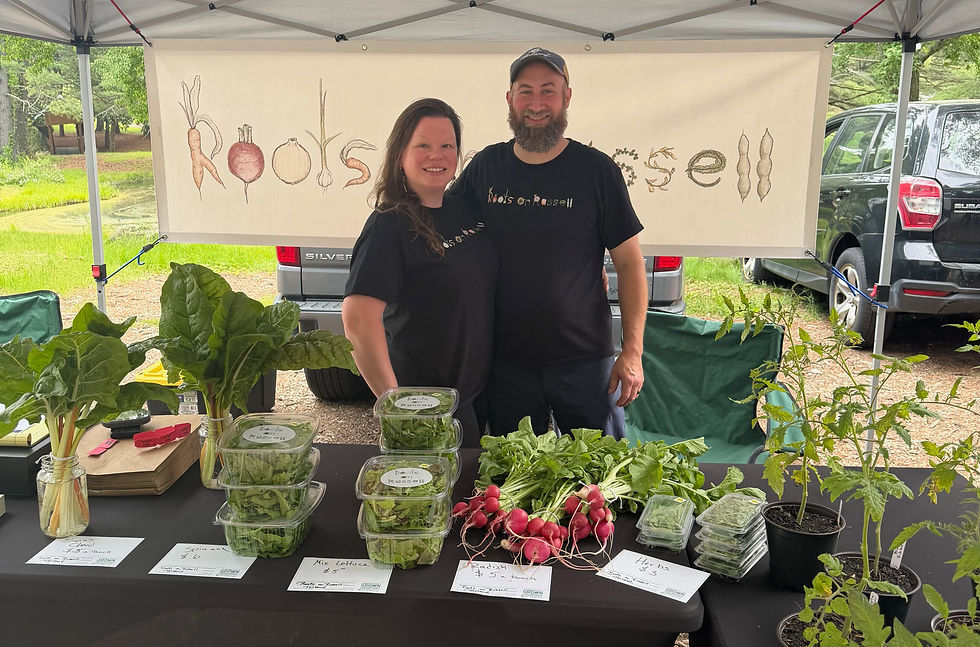
Managing the Stafford Farmers Market is mostly Kathryn’s effort since Tim works during the hours she is contacting people, soliciting vendors, getting sponsors, and so on. It’s a lot of work but she really enjoys the networking. Selling their produce at markets is very satisfying. They enjoy seeing regulars excited about what they bring every week. “We might make $5 a week on Swiss chard but we made that person’s day,” says Kathryn. “For me, that’s worth it.”
“We’re still very new to the game,” Tim admits. “But we like doing this for people. We’ve always been the ones to give someone a ride or lend a hand with something. And that’s a big part of growing, that we can help others.”
You can find Roots on Russell at the Tolland Green Market, Sundays from 10am to 1pm. You can also meet Kathryn and Tim at the Stafford Farmers Market on Saturdays from 11am to 1pm. Follow Roots on Russell on Instagram @RootsOnRussell.